Outdoor lighting at a hotel has to do a lot more than make the property visible after dark.
It needs to help guests safely navigate parking lots and walkways. It needs to create an inviting entrance. It needs to complement the architecture and landscaping. It needs to withstand years of exposure to the elements.
And it needs to accomplish all of that without making a beautiful hospitality property feel like a brightly lit parking garage.
That is why commercial outdoor lighting for hotels should be approached as a complete system rather than a collection of individual fixtures.
From wall packs and bollards to canopy fixtures, area lights and architectural lighting, every fixture has a different job to do.
Here are some of the technical considerations contractors, developers and property owners should think about when selecting exterior lighting for a hotel or resort.
Start with the different areas of the property
A hotel exterior is not one lighting environment.
It may include:
- Parking lots
- Parking structures
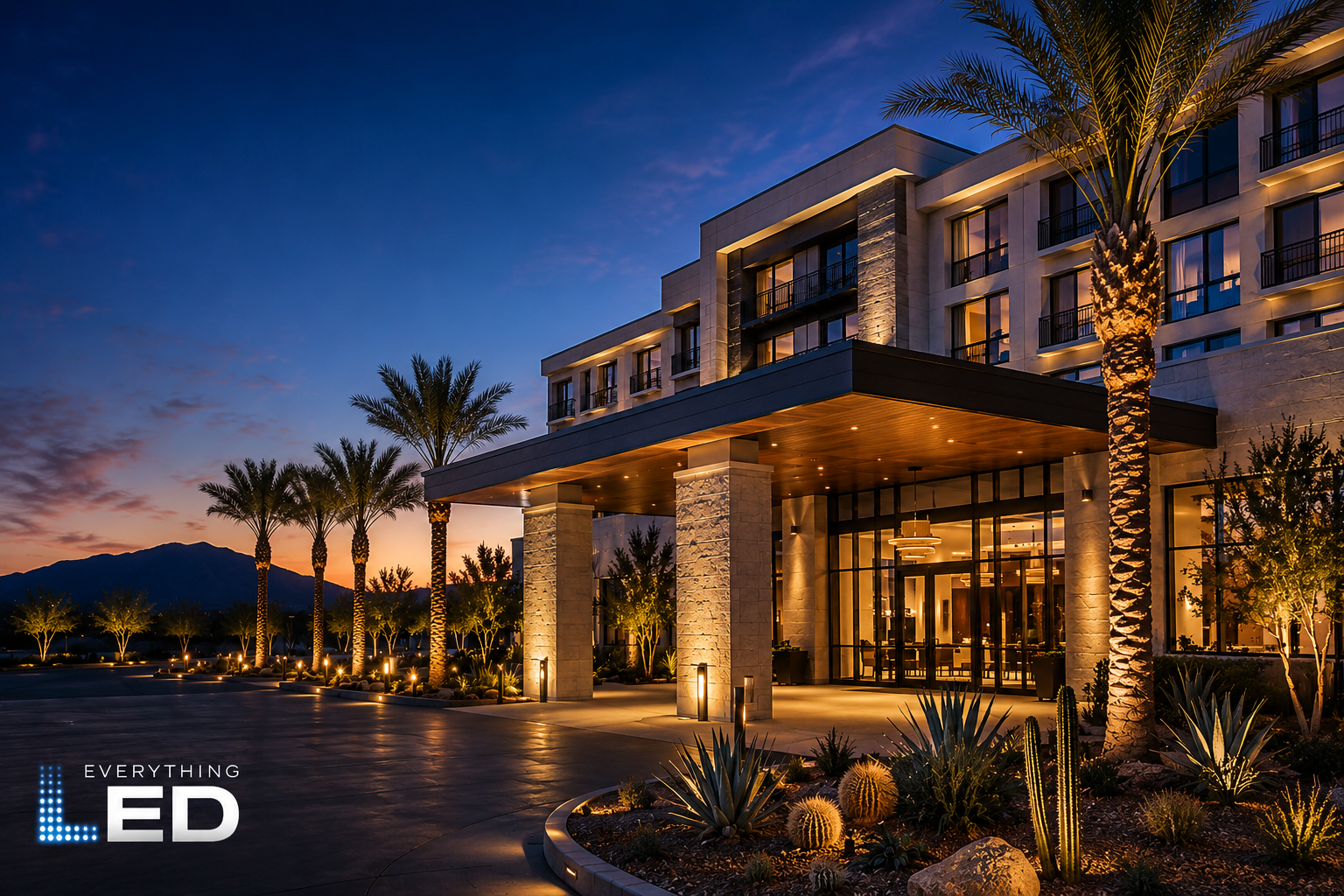
- Porte cochères and covered entrances
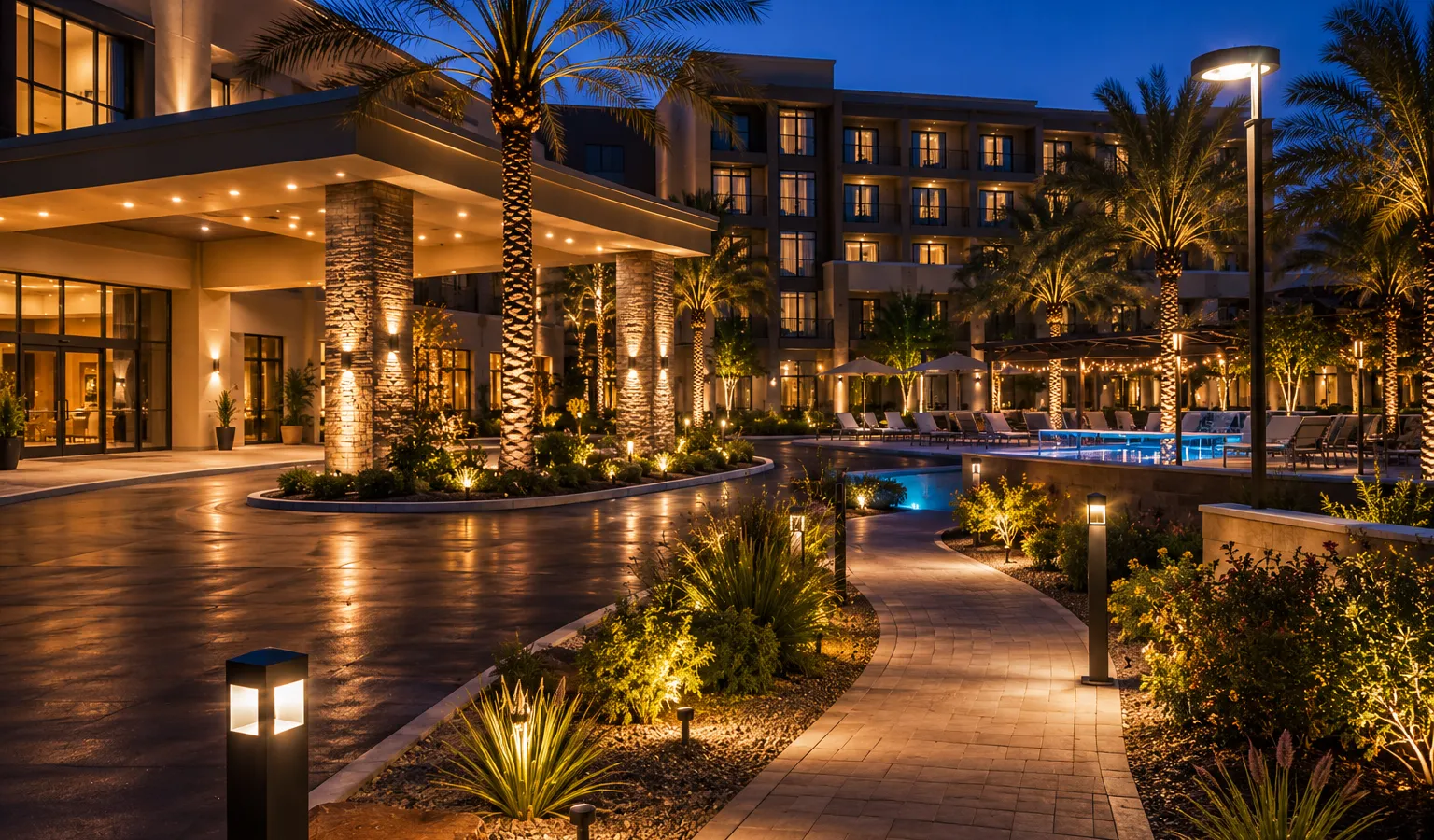
- Pedestrian walkways
- Building entrances
- Exterior corridors
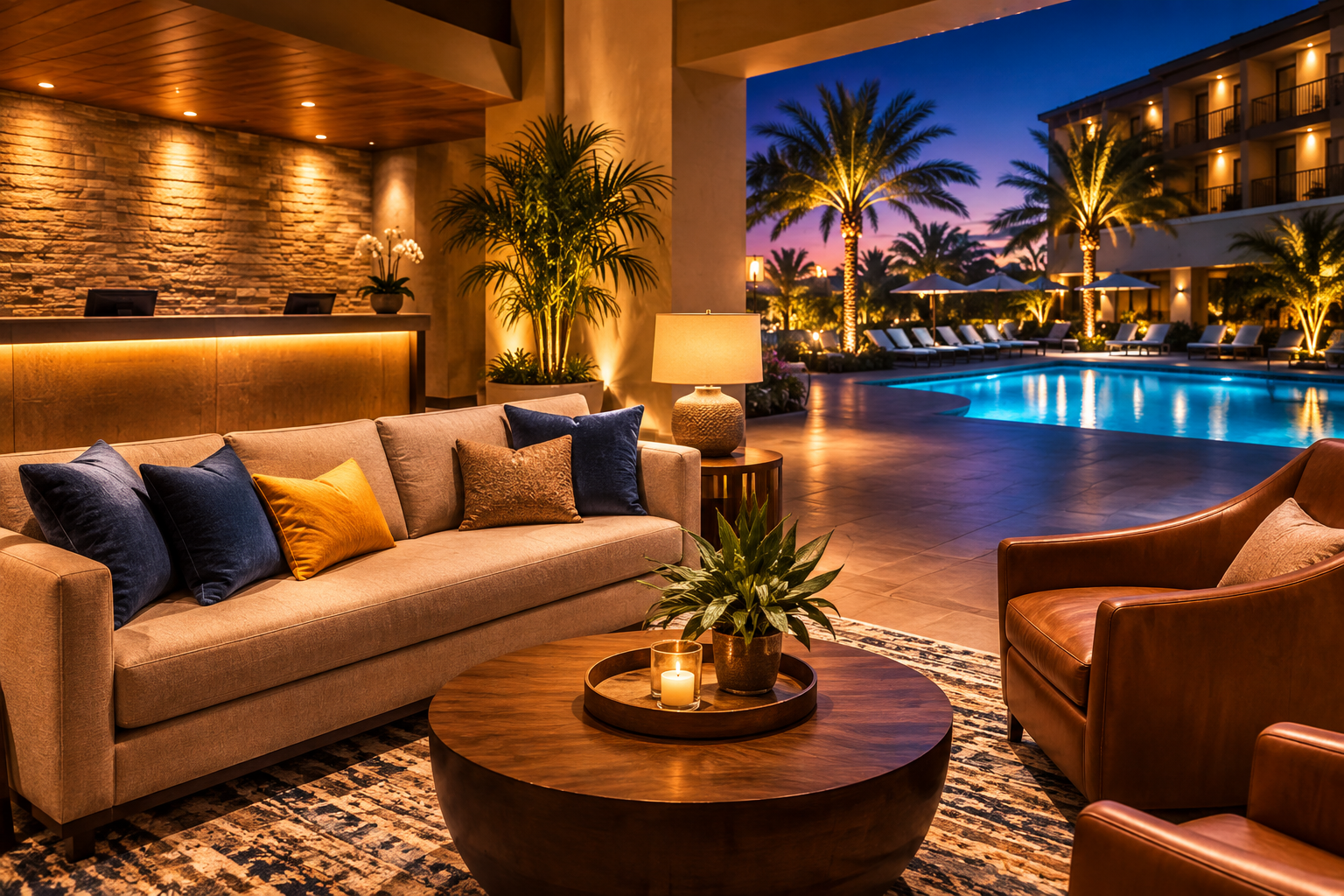
- Patios and courtyards
- Pool areas
- Landscaping
- Outdoor dining areas
- Building facades
- Service areas and signage
Each space has different lighting requirements.
A parking area may prioritize visibility and uniform light distribution. A walkway needs enough illumination for guests to comfortably navigate the property. A covered entrance may need canopy lighting that provides excellent visibility without creating uncomfortable glare. A patio or courtyard may need softer architectural lighting designed to preserve atmosphere.
Trying to solve every application with the same fixture type, output or color temperature can result in an exterior lighting plan that technically produces light but does not perform particularly well anywhere.
Outdoor fixtures need to be rated for the environment
Exterior fixtures have to withstand conditions interior fixtures never encounter. Rain, dust, irrigation, heat, temperature changes and constant exposure to the elements all affect fixture performance.
That makes wet location ratings and IP ratings important specifications to review when sourcing commercial outdoor lighting. An IP rating describes the level of protection a fixture enclosure provides against solids and moisture, and the appropriate rating depends on where and how the fixture will be installed.
A fixture underneath a protected canopy does not experience the same conditions as an exposed landscape fixture near irrigation or a fixture installed close to a pool.
The important thing is not simply choosing the highest number available. It is choosing a fixture that is appropriately rated for its actual installation environment.
Contractors should verify the wet location rating, IP rating and manufacturer installation requirements before ordering exterior fixtures.
Arizona heat matters too
Water is not the only environmental consideration in Arizona. Heat matters.
Exterior fixtures installed around hotels, parking areas and building facades can be exposed to extremely high temperatures, particularly when mounted in locations receiving direct afternoon sun.
LED fixtures have published operating temperature ranges, and those specifications should be reviewed during product selection. A fixture that looks right and produces the correct amount of light still needs to be appropriate for the environment where it will spend the next several years.
For Arizona projects, temperature tolerance should be part of the sourcing conversation, not an afterthought.
Lumens matter more than simply comparing wattage
Wattage tells you how much power a fixture consumes. It does not tell you exactly how much usable light reaches the area you are trying to illuminate.
For LED lighting, lumen output and fixture efficacy provide much more useful information. Two fixtures with similar wattages may produce different lumen outputs or distribute that light very differently.
That becomes especially important in parking lots, walkways and larger exterior areas.
Instead of asking only how many watts a fixture draws, the better questions are: how much light does it produce, where does that light go, and is that distribution appropriate for the application?
Light distribution can be just as important as output
More light is not automatically better light. The way a fixture distributes illumination can dramatically affect how well it performs.
Parking lot fixtures, wall mounted fixtures, bollards, flood lights and pathway fixtures all use different optics to direct light where it is needed.
A fixture with the wrong distribution may create bright areas directly beneath the light while leaving large dark areas between fixtures. Another may send unnecessary light beyond the property or toward guest room windows.
Proper fixture selection considers mounting height, spacing, beam spread, optics and the area the fixture actually needs to illuminate.
This is also why fixture substitutions should be evaluated carefully. A replacement fixture may have similar wattage and lumen specifications but perform very differently if the optics and distribution are not comparable.
Pay attention to glare
One of the easiest ways to make an outdoor hospitality space uncomfortable is excessive glare.
Guests should not have to look directly into intense light sources while walking toward an entrance, sitting on a patio or moving around a pool area.
Fixture placement, shielding, mounting height and optics can all help control glare. This is especially important in hospitality environments because outdoor lighting is doing two jobs at once. It needs to provide useful illumination, and it needs to preserve the atmosphere of the property.
The goal should be to put light where people need it without making the light source itself the most noticeable thing in the space.
Color temperature changes how a property feels
Color temperature is measured in Kelvin and has a major effect on the appearance of exterior spaces.
Warmer color temperatures can create a softer, more relaxed atmosphere that often works well around hotel entrances, patios, landscaping and gathering spaces. Cooler color temperatures may be appropriate in certain commercial or service applications where visibility is the primary objective.
The exact choice depends on the property, architecture, application and design intent. What matters just as much is consistency.
Installing noticeably different color temperatures next to one another can make a property look mismatched, particularly when replacement fixtures are added over time.
For large hospitality projects, establishing a color temperature strategy early can help keep the finished property visually cohesive.
Controls can reduce unnecessary energy use
Hotel exterior lighting often operates for long periods every day. That makes lighting controls an important part of the system.
Depending on the application, controls may include:
- Photocells
- Timers
- Dimming
- Occupancy or motion sensors
- Building lighting control systems
A parking area may require illumination throughout the night while certain secondary areas can potentially operate at reduced output when activity is low. Photocells can automatically respond to daylight conditions. Dimming can provide additional flexibility.
The appropriate control strategy depends on the property and local requirements, but controls should be considered while fixtures are being selected rather than after everything has already been ordered.
Pools, patios and courtyards require a different approach
Hospitality properties often include outdoor spaces designed specifically for guests to spend time in. These areas should not necessarily be illuminated like parking lots or service areas.
Pool decks, patios, courtyards and outdoor dining areas may use several layers of lighting. Pathway lighting can support navigation. Architectural lighting can highlight building features. Landscape lighting can add depth. Decorative fixtures can reinforce the design of the property.
The technical specifications still matter, particularly around wet environments, but the goal changes. These spaces need enough light to function safely while maintaining the atmosphere that makes guests want to use them.
Consider light spill and the surrounding property
Exterior lighting does not stop at the edge of the fixture. Poorly controlled light can spill into guest rooms, neighboring properties or areas that do not need illumination. That can create both design and compliance problems.
Fixture optics, shielding, mounting angles and cutoff characteristics can help keep light directed where it belongs. Local lighting ordinances and project requirements should also be reviewed when exterior lighting is being designed or replaced.
In Arizona communities where reducing unnecessary nighttime light is a priority, this consideration can become especially important.
Maintenance should be part of fixture selection
Hotels operate every day. That makes maintenance interruptions expensive and inconvenient.
Exterior lighting should be evaluated not only by purchase price but also by expected service life, accessibility and replacement availability. Consider questions such as:
- How difficult will this fixture be to access?
- Will replacement drivers or components be available?
- Is the fixture family likely to remain available when another phase of the project begins?
- Can the same fixture or a compatible replacement be sourced later?
A lower initial fixture cost does not always result in the lowest long term cost if the product becomes difficult to maintain or impossible to match.
One hotel may require many different fixture types
This is where commercial hospitality lighting projects can become complicated quickly.
One property may require LED area lights, wall packs, bollards, canopy fixtures, flood lights, architectural wall fixtures, pathway lighting, landscape lighting and decorative exterior fixtures.
Those products still need to work together. Color temperature needs to remain consistent where appropriate. Finishes may need to coordinate. Controls need to be compatible. Lead times need to fit the construction schedule. And if the project is being completed in phases, fixtures may need to remain available months later.
The challenge is not simply finding an outdoor LED fixture. It is sourcing an entire exterior lighting package that works as a system.
Good outdoor lighting is technical before it ever looks effortless
When guests walk through a beautifully illuminated hotel property, they probably are not thinking about lumen output, beam distribution, IP ratings, controls or operating temperatures.
They should not have to. Those decisions were made long before the guest arrived.
Everything LED Lighting helps contractors, developers, electricians and commercial property teams source LED lighting for hospitality projects throughout Arizona. From parking areas and building entrances to pathways, courtyards and other exterior spaces, our team can help identify fixtures that meet project requirements while coordinating availability, consistency and lead times across the lighting package.
Because the right outdoor lighting is not simply about making a property brighter. It is about putting the right light, in the right place, with the right fixture for the job.
Frequently Asked Questions
What IP rating do hotel outdoor light fixtures need?
It depends on the installation location. A fixture under a protected canopy faces different conditions than an exposed landscape fixture near irrigation or a fixture close to a pool. Verify the wet location rating, IP rating, and manufacturer installation requirements for each application rather than defaulting to the highest number available.
Should I compare outdoor fixtures by watts or lumens?
Lumens, plus distribution. Wattage only tells you power draw. Two fixtures at similar wattage can produce different lumen output and send that light in very different directions, which matters most in parking lots, walkways, and large exterior areas.
What color temperature works best for hotel exteriors?
Warmer color temperatures generally suit entrances, patios, landscaping, and gathering spaces, while cooler temperatures can fit service or high-visibility applications. Consistency across the property matters as much as the specific number, especially when fixtures get replaced over time.
Why does one hotel need so many different fixture types?
A hotel exterior includes parking, entrances, walkways, facades, patios, pools, landscaping, and service areas, and each has different requirements. The package may include area lights, wall packs, bollards, canopy fixtures, flood lights, pathway and landscape lighting, all of which still need to coordinate on color temperature, finish, controls, and lead time.
Planning exterior lighting for a hospitality project?
Share the areas, fixture types, and construction schedule. We'll help match products to each application and keep the package consistent across phases.