A box can say LED, commercial grade and energy efficient and still leave the contractor with unanswered questions.
Is the exact model properly listed? Is it approved for the location where it will be installed? Will it work with the controls on the drawings? Does it qualify for the rebate included in the owner’s budget? Can the same fixture be sourced when the next building starts six months from now?
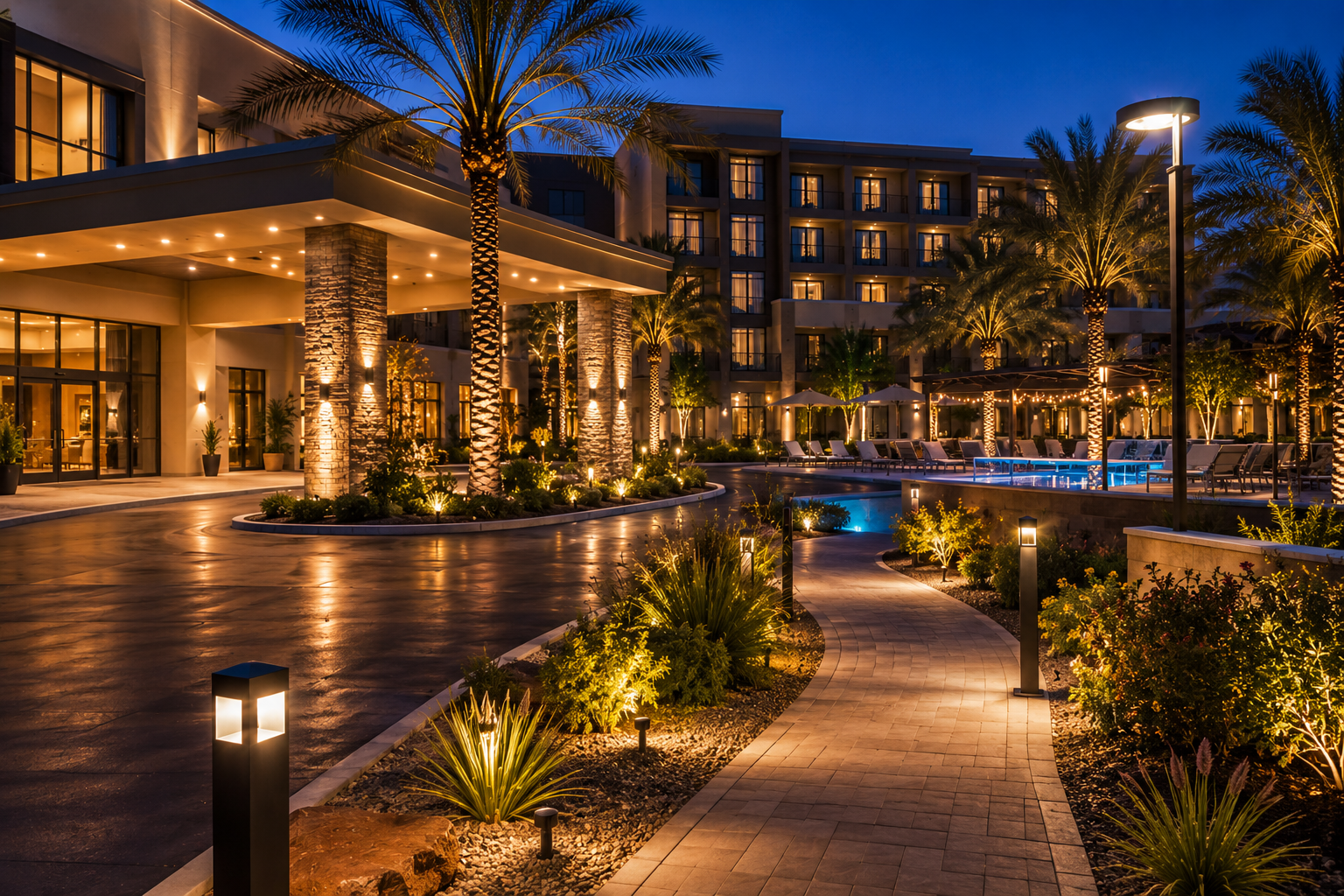
Those questions matter on any commercial lighting project. They matter even more in Arizona hotels and apartment communities, where one product decision may be repeated across hundreds of guest rooms, units, corridors, stairwells, parking areas and exterior spaces.
Product verification is not about making the submittal process more complicated. It is about catching expensive problems before fixtures are ordered, delivered and installed.
Start with the project location and code path
The first question is not simply whether a fixture is “code compliant.” The better question is: compliant with which requirements for this project?
Building and energy-code requirements can differ by jurisdiction, project type and permit date. Phoenix, for example, adopted its 2024 Phoenix Building Construction Code, effective August 1, 2025. A project in another Arizona city may be reviewed under a different code edition or different local amendments.
Hotels and larger multifamily buildings generally fall under commercial energy-code provisions. The U.S. Department of Energy identifies hotels and multifamily buildings of four stories or more as commercial buildings, while low-rise multifamily buildings may follow residential provisions. Its building energy-code overview explains the distinction between the IECC and ASHRAE 90.1 pathways.
Before approving a fixture, contractors should confirm the authority having jurisdiction, the adopted code edition, the approved lighting plans and any local amendments. The plans and specifications should answer questions about lighting power, controls, emergency lighting and exterior requirements. If they do not, ask before ordering.
Verify the safety listing on the exact product
UL and ETL marks are familiar, but the logo alone is not the complete verification.
The model number on the fixture, carton, cut sheet and certification record should agree. The certification should apply to the exact product being supplied, not merely to a similar fixture family or a manufacturer’s other products.
OSHA’s Nationally Recognized Testing Laboratory program identifies organizations recognized to test and certify products for applicable safety standards. The current list includes laboratories such as UL Solutions and Intertek, which operates the ETL certification program.
When reviewing a product, confirm:
- The certification mark is from a recognized testing laboratory.
- The exact model or approved product family appears in the certification record.
- The fixture is certified for its intended use and installation method.
- Any field-installed options, emergency drivers or retrofit components are covered by the instructions and listing.
A CE mark or an unsupported claim of “UL compliant” is not the same as a product certification from a recognized U.S. testing laboratory.
Match the fixture to the Arizona environment
Arizona adds a practical question that can be overlooked in a comfortable office: how hot will this location actually become?
An exterior wall pack in afternoon sun, a canopy fixture over pavement and a luminaire inside an enclosed ceiling space may experience temperatures far above the outdoor forecast. The fixture’s published ambient operating range should be checked against the real installation environment.
Heat affects drivers, batteries, controls and LED life. A fixture can be efficient on paper and still be a poor fit if its components are operating near or beyond their rated temperature for long periods.
Location ratings matter too. A covered hotel entry, an exposed apartment walkway, a pool area and a landscape fixture near irrigation do not face the same conditions. Verify whether the product is listed for dry, damp or wet locations and review the manufacturer’s mounting requirements.
Our guide to outdoor lighting for Arizona hotels explains why temperature range, moisture protection, optics and glare should be evaluated together.
Do not let a substitution change the lighting design
Two fixtures can have the same wattage and still perform very differently.
The replacement product may produce more or fewer lumens. It may distribute light differently, create more glare or shift the color temperature. Its color rendering may make paint, flooring and furnishings look different. Its dimensions may also affect ceiling openings, mounting plates or architectural details.
That is why a substitution should be compared by more than price and wattage. Review the lumen output, efficacy, distribution, photometric file, color temperature, color quality, dimensions, finish and mounting details.
For hotels, this protects the guest experience. For apartments, it helps keep buildings, corridors and unit interiors visually consistent. Residents and guests may never read the cut sheet, but they will notice mismatched light colors and uncomfortable glare.
The same principle appears in our article on why thoughtful hotel lighting makes guests want to stay longer. The technical choices happen early, but the emotional result is experienced every day.
Confirm controls before the fixtures ship
“Dimmable” is not a complete controls specification.
A fixture may use 0-10V dimming, phase dimming, DALI or a manufacturer-specific control method. The driver may have a limited dimming range or require particular wiring. Sensors, emergency drivers and networked controls may add additional compatibility requirements.
Before ordering, compare the fixture and driver information with the approved controls package. Confirm the protocol, voltage, wiring, dimming range and any tested compatibility information. If a mockup or sample is needed, complete it before the full shipment arrives.
This step is especially important in hotel guest rooms, corridors, clubhouses and apartment amenity spaces where dimming quality affects comfort. It also matters in parking structures, stairwells and back-of-house areas where occupancy controls may be part of the energy strategy.
Check DLC qualification and rebates separately
Safety certification, code compliance and rebate eligibility are related, but they are not the same thing.
The DesignLights Consortium maintains a Qualified Products List for high-performing commercial LED lighting. A DLC listing can be important when a utility program requires an eligible product, but it does not replace the safety listing or the local code review.
Arizona utility programs can also differ by service territory, project type and available funding. SRP lists business rebates for LED lighting, while APS maintains its own Solutions for Business program. Requirements and funding can change, so eligibility should be confirmed before the owner is promised a rebate or the purchase order is released.
Capture the exact manufacturer and model number used in the application. A last-minute substitution may change rebate eligibility even if the replacement fixture appears similar.
Verify the product can be supported after turnover
Passing inspection is important. So is being able to maintain the property three years later.
Hotels and apartment communities often use the same fixture across many rooms or buildings. If that product is discontinued, changes appearance or becomes difficult to source, a simple replacement can turn into a property-wide consistency problem.
Ask the supplier:
- Is the fixture a current product or nearing the end of its line?
- Are replacement drivers, modules, lamps or lenses available?
- How long is the warranty, and which components does it cover?
- Will the same finish, output and color temperature be available for later phases?
- What attic stock should be included at turnover?
Everything LED Lighting is built around this part of the project. We help teams source matched fixtures, coordinate product across phases and keep lead times visible so a lighting package works with the construction schedule, not against it.
Use a simple pre-installation fixture check
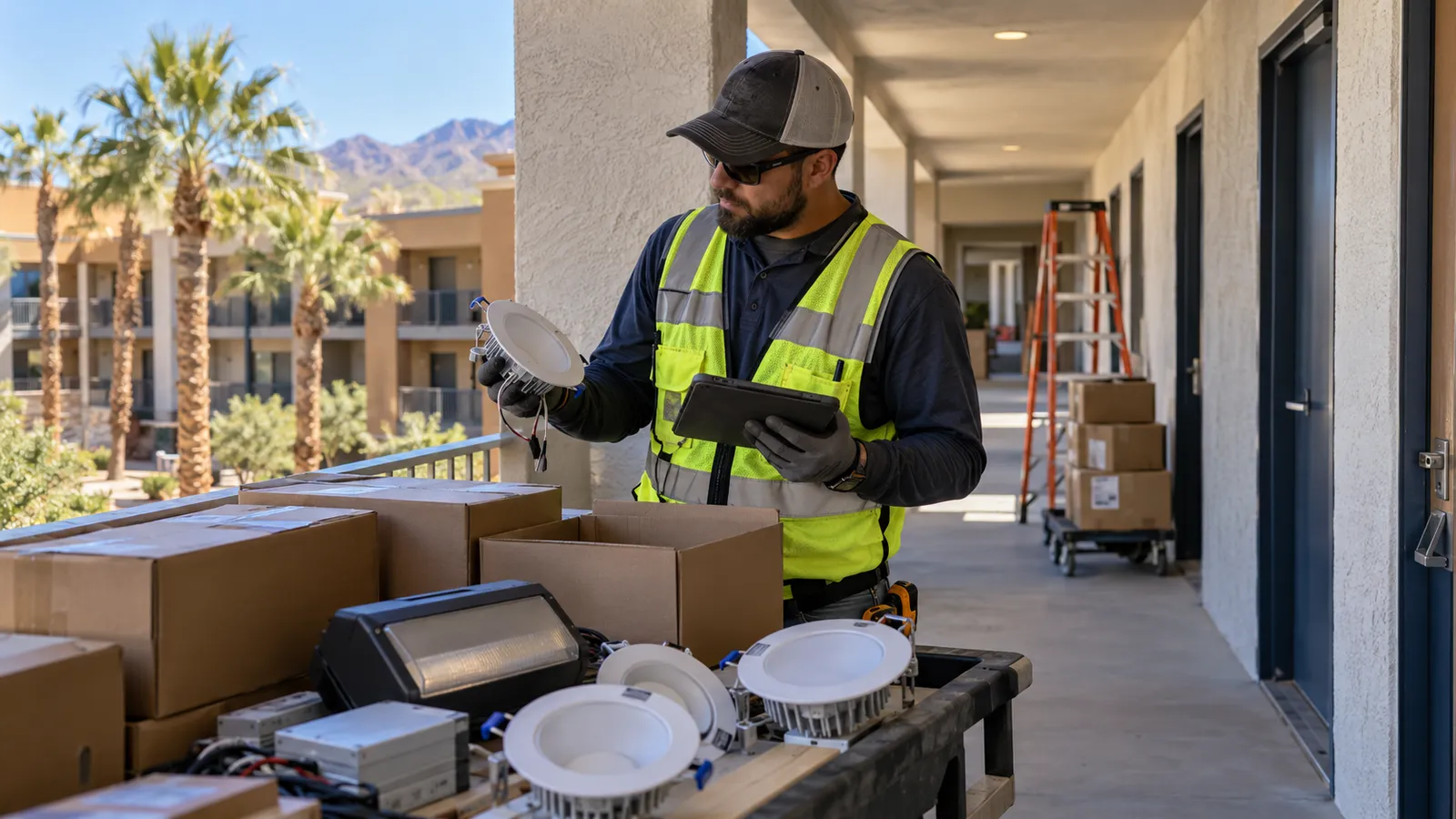
The best time to find a mismatch is while one carton is open, not after 200 fixtures are mounted.
Before installation begins, compare the delivered product with the approved submittal. Check the manufacturer, model number, wattage, color temperature, voltage, driver, finish and listed accessories. Confirm that the certification and location markings are present on the product.
If the project uses selectable wattage or selectable color temperature, document the required settings and verify them before fixtures are installed throughout the property. A quick field check can prevent one building from ending up at 3000K while the next is set to 4000K.
For larger scopes, photograph the label and approved settings, then include that information in the closeout package. This gives the owner and maintenance team something more useful than a generic box marked “LED fixture.”
Watch for common red flags
Pause the order or installation if:
- The model number on the carton does not match the submittal.
- The cut sheet does not identify the required safety certification.
- The product is described as “equivalent” without photometric or dimensional comparison.
- The ambient temperature range is missing or unsuitable for the location.
- Wet or damp location markings do not match the installation.
- The driver and control method are unclear.
- A rebate is part of the budget, but the exact model has not been checked for eligibility.
- The supplier cannot explain the warranty or replacement path.
None of these automatically means the product is unusable. They mean the question should be resolved before installation makes the answer expensive.
Verification protects the entire project
The right LED product does more than turn on.
It passes inspection. It performs in Arizona heat. It works with the controls. It produces the light the design expected. It remains consistent across the property. And when something eventually needs service, the owner knows what was installed and how to replace it.
That is the real purpose of product verification.
Everything LED Lighting helps electrical contractors, developers and property teams source commercial LED lighting for hotels and multifamily projects throughout Arizona. We review the application, coordinate the fixture package, support product matching and help keep purchasing aligned with project schedules and long-term maintenance needs.
Because the least expensive time to solve a product problem is before the fixture reaches the ceiling.
Frequently Asked Questions
Does Arizona have one lighting code for every hotel and apartment project?
Project requirements depend on the local authority having jurisdiction, adopted code edition, building type, permit date and local amendments. Confirm the code path with the design team and jurisdiction instead of assuming requirements are identical across Arizona cities.
Is a DLC listing the same as a UL or ETL safety certification?
No. DLC qualification evaluates commercial lighting products against energy and performance requirements and is often used by rebate programs. UL or ETL certification addresses applicable product safety standards. A project may require both, along with local code compliance.
What should contractors check for Arizona heat?
Review the fixture’s published ambient operating temperature, driver rating and installation instructions. Consider the actual mounting location, including direct sun, enclosed spaces, rooftops, canopies and pavement that can increase surrounding temperatures.
When should rebate eligibility be verified?
Before the owner is promised an incentive and before the purchase order is released. Confirm the serving utility, current program status, application timing and exact eligible model. Recheck eligibility if the fixture is substituted.
How can contractors prevent mismatched lighting across a large property?
Document the approved manufacturer, model, wattage, color temperature, finish, driver and selectable settings. Verify the first delivered fixtures before installation, maintain approved alternates and include attic stock and complete fixture schedules at turnover.
Need help verifying an Arizona lighting package?
Send us the fixture schedule, property type, project location and construction timeline. We can help review product options, availability and consistency before the order reaches the jobsite.