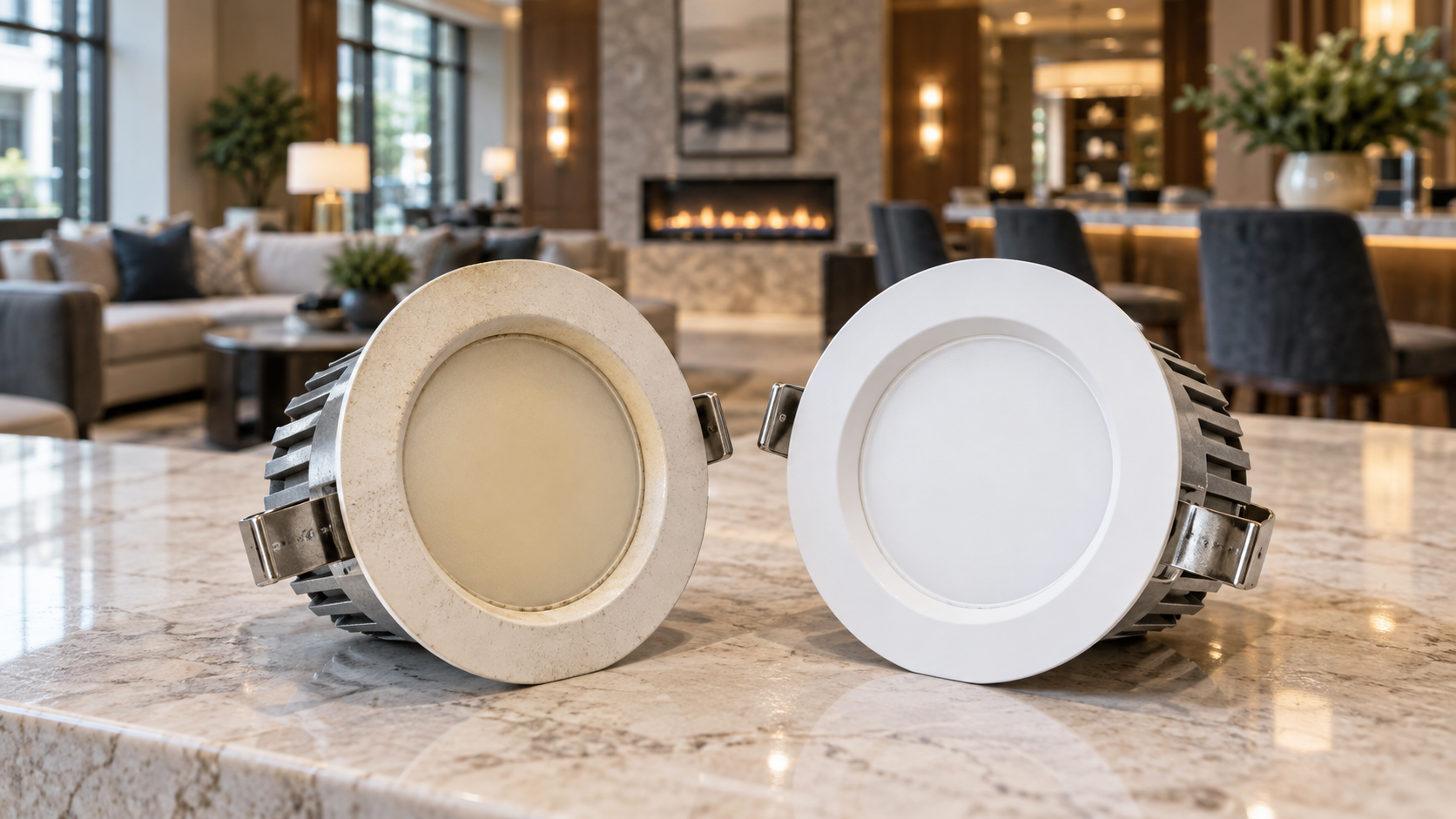

One Small Switch Can Affect Hundreds of Fixtures
On a hotel or multifamily project, one lighting decision may be repeated in every guest room, apartment, corridor, utility area and building phase. That is why field-selectable LED fixtures have become so attractive.
Instead of stocking separate fixture models for every wattage or color temperature, a contractor may be able to order one product and choose the required setting during installation. That can simplify purchasing, reduce the number of SKUs and provide welcome flexibility when the conditions in the field do not match the original assumptions.
The same flexibility can also create a new kind of punch-list problem. If one building is set to 3000K and another is set to 3500K, or fixtures in the same corridor are operating at different wattages, the products may all be technically functional while the finished property looks inconsistent.
A recent ArchLIGHT Summit discussion about selectable lighting captured the issue well. Flexibility has real value, but it does not automatically protect design intent.
What Is a Selectable LED Fixture?
A selectable LED fixture includes one or more switches that allow certain operating characteristics to be chosen in the field. Depending on the product, the installer may be able to select:
- Color temperature, such as 2700K, 3000K, 3500K, 4000K or 5000K
- Wattage or lumen output
- Beam angle or light distribution
- Sensor or control behavior
These adjustments are different from a tunable-white control system. A selectable fixture usually offers several fixed stops chosen at the fixture. Tunable-white lighting can change across a continuous range through a control system after installation.
That distinction matters. A five-position CCT switch may solve a purchasing problem, but it does not turn the fixture into a programmable hospitality lighting system.
Why Contractors Like Selectable Fixtures
Fewer Products to Source and Track
A single selectable model may cover several spaces that would otherwise require separate fixture configurations. That can make the quote easier to manage and reduce the chance that one low-volume variation gets missed during ordering.
More Flexibility When Conditions Change
Construction documents do not always capture every field condition. A corridor may feel darker after finishes are installed. A utility room may need less output than expected. A model room may show that 4000K feels too cold for the property. Selectable fixtures allow some corrections without returning and reordering the entire package.
Simpler Inventory for Repeated Spaces
Multifamily and hotel projects frequently use the same fixture across many units or operational spaces. Standardizing around fewer products can simplify deliveries, staging and attic stock. Everything LED already emphasizes matched fixtures across multifamily and hospitality projects because consistency becomes a procurement issue when the same decision is repeated property-wide.
Where the Field Risk Begins
The Approved Setting May Not Reach the Installer
The submittal may identify the fixture model but fail to clearly state the selected wattage or color temperature. If the switch ships at a factory default, different crews may make different assumptions. The result may not be discovered until the punch walk, when hundreds of fixtures are already installed.
Matching CCT Labels Can Still Look Different
Two products marked 3000K do not always appear identical. LED binning, color tolerance, optics, diffusion and the way a selectable fixture creates each setting can all affect the final appearance. This is especially noticeable when fixtures are installed near each other or illuminate the same paint, flooring, tile or wood finish.
For visible spaces, reviewing a sample under the actual finish palette is more reliable than choosing by the CCT label alone. Our article on why paint and finishes look different under LED lighting explains why the light source and the material have to be evaluated together.
Switches Can Become Inaccessible
Some selectors are easy to reach before installation but difficult to access once a fixture is mounted, a ceiling is closed or a driver is placed above a hard lid. Contractors should confirm when the setting must be made and whether it can be checked later without removing the fixture.
Controls and Emergency Options Still Need Coordination
Selectable wattage or CCT does not guarantee compatibility with the project dimming system, occupancy sensors, emergency drivers or building controls. The fixture, driver, voltage, control method and emergency operation still need to be reviewed as one system.
That review belongs in the same release process used for any commercial package. The commercial lighting pre-order checklist for contractors covers the voltage, mounting, controls, availability and documentation details that should be confirmed before products are ordered.
Where Selectable Fixtures Make the Most Sense
Selectable products are often strongest in repeated, practical spaces where flexibility and inventory control matter more than highly specialized optical performance. Hotel back-of-house areas, apartment utility rooms, storage spaces, laundry rooms, service corridors and some parking or canopy applications may all be good candidates.
They can also work well in apartment interiors and guest rooms when the project team approves the setting through a model unit and applies the same configuration consistently across the property.
More caution is appropriate in lobbies, leasing offices, clubhouses, restaurants, decorative corridors and other visually sensitive spaces. In those areas, beam control, dimming quality, glare, finish appearance and color consistency may justify a more tightly specified fixed-output or architectural fixture.
The decision is similar to choosing between lamp-ready and integrated LED fixtures. No single approach is right for every space. The best product is the one that fits the installation, the design expectations and the owner’s long-term maintenance plan.
How Contractors Can Protect the Project
The fixture itself is not the biggest risk. The risk is leaving the final configuration undocumented.
Before releasing or installing a selectable lighting package:
- Approve the exact wattage, CCT and other settings for every fixture type.
- Add those settings to the fixture schedule, submittal and installation notes.
- Configure and review one model room, unit, corridor section or representative area before repeating the installation.
- Verify the switch position during installation instead of relying on the factory default.
- Include selectable settings in the punch-list inspection and closeout photographs.
- Label attic stock and document the approved configuration for the facility team.
On a phased Arizona hotel or apartment project, the closeout record should also be carried into later releases. A fixture family may remain available while its factory defaults, driver or internal components change. Keeping the approved settings and product details together helps later phases match the original installation.
Flexibility Is Valuable When It Is Controlled
Selectable LED fixtures can reduce inventory, simplify procurement and give contractors useful room to respond to real jobsite conditions. Those are meaningful advantages on large hotel and multifamily projects.
But a field-adjustable product transfers one decision from the factory to the project team. Someone must approve the setting, communicate it to the installer, verify it in the field and preserve it for the owner.
When that responsibility is clear, selectable fixtures can make a project easier. When it is not, the same flexibility can produce mismatched rooms, uneven corridors and expensive callbacks.
Everything LED Lighting helps contractors, developers and property teams compare commercial LED fixtures, maintain consistency across phased projects and coordinate the details that protect installation and turnover. If you are building or renovating a hotel, apartment community or mixed-use property, send us your fixture schedule and project timeline before the package is released.
Frequently Asked Questions
Are selectable LED fixtures the same as tunable-white fixtures?
No. A selectable fixture normally offers several fixed color-temperature settings chosen at the fixture. Tunable-white lighting changes through a control system and may provide a continuous range after installation.
Should the electrician choose the CCT in the field?
The electrician may physically set the switch, but the approved CCT should come from the project documents, design team or owner. Leaving the decision to individual installers can create inconsistent results.
Can one selectable fixture be used throughout an entire apartment property?
Sometimes, especially in repeated practical spaces. However, guest-facing and amenity areas may need different optics, dimming performance, finishes or glare control. Standardization should not override the requirements of the space.
What should be included in the closeout documents?
Record the full model number, approved wattage, CCT, control settings, emergency configuration, warranty information and attic-stock requirements. Photographs of the selector positions can also help the facility team maintain consistency.